
Glazing decisions
Acrylic or glass for picture framing?
We sell both, so we have no side to take — the honest answer is that each wins different jobs. Acrylic glazing (PMMA, what most people call plexiglass) beats glass on weight and safety; glass beats acrylic on surface hardness and price. Here is how we choose at our own framing counter.
Choose glass when…
- The frame is a standard size and stays on one wall
- Budget matters — anti-reflective glass costs less per m²
- The surface will be cleaned often or handled roughly
- You are framing pastel, charcoal or other loose media
Choose acrylic when…
- The frame is large — half the weight changes everything
- The work travels, ships or hangs in a public space
- Shattering is unacceptable: children’s rooms, corridors, schools
- You want museum optics without museum weight
Side by side
The differences that matter
Comparing the two ends of our own range: Artglass anti-reflective framing glass and Artglass Lifetime Acrylic, both made by Groglass in Riga. With both, you can have ~1% reflection and conservation-grade UV protection — the real choice is physical, not optical.
| Framing glass | Lifetime Acrylic | |
|---|---|---|
| Weight | The heavy classic — plan hangers accordingly | Roughly half the weight of glass |
| If it breaks | Can shatter — laminated AR Protect exists for safety-critical walls | Shatter-resistant |
| Optics available | ~1% reflection · ~98% transmission · up to 99% UV | ≤1.1% reflection · ~98% transmission · ~99% UV |
| Thickness | 2 mm standard; 3 / 4.4 mm in large formats | 3 / 4.5 / 6 mm — thicker for bigger frames |
| Largest sheets | Up to 2210 × 3160 mm (A-frame formats) | Up to 1970 × 2580 mm |
| Scratch resistance | Hardest surface — very difficult to scratch | Hard-coated and scratch-resistant (unlike ordinary acrylic) |
| Static | None | Anti-static coating; ordinary acrylic is static-prone |
| Cleaning | Like any glass | Easy — soft cloth, non-abrasive cleaner |
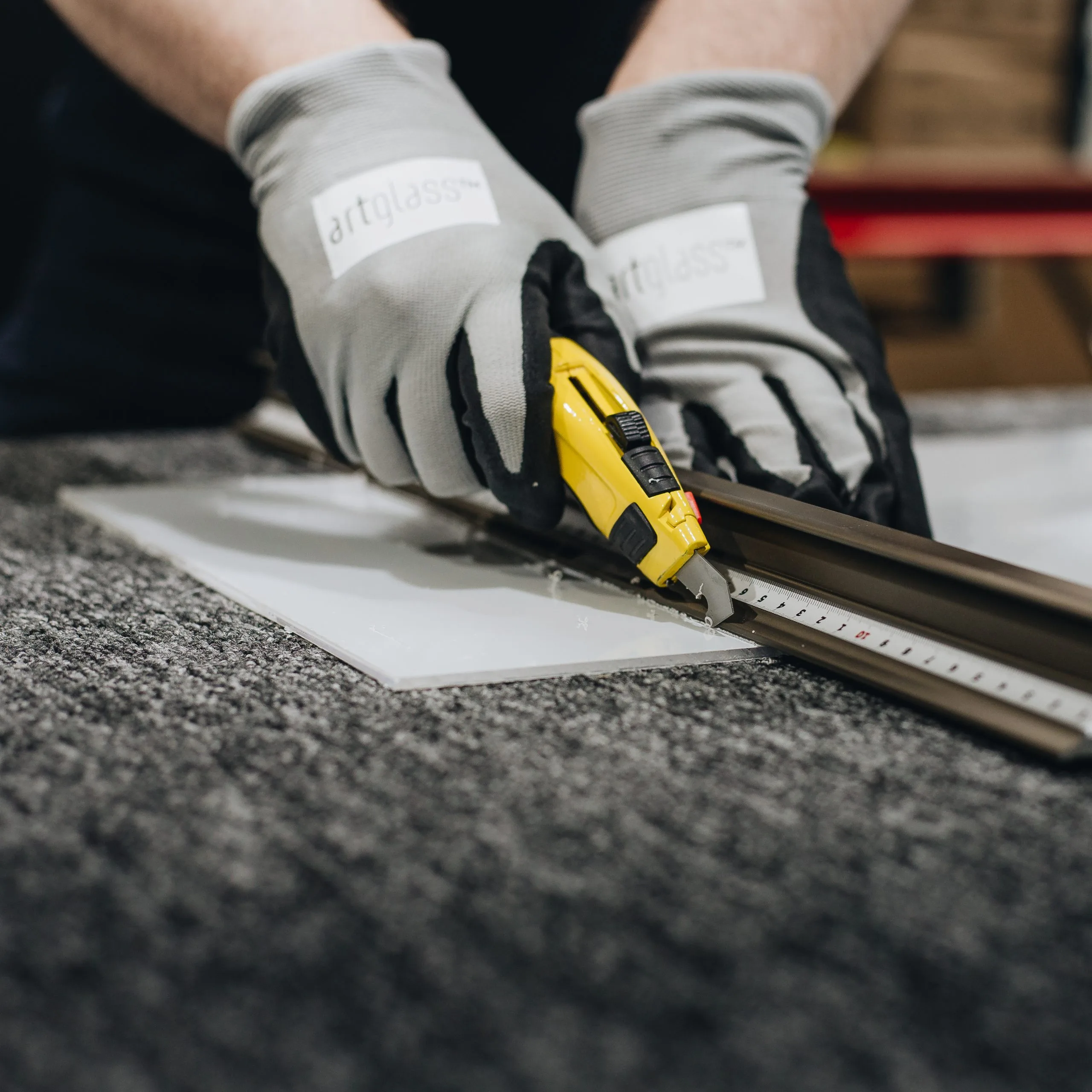
| In the workshop | Cuts with regular tools, from either side | Multi-material cutters; power saws for 4.5 / 6 mm |
| Buying it | By the box of 2 sheets, crated freight — quoted individually | Any quantity, even one sheet — instant prices online |
| Cost | Lower cost per m² | Premium per m² — the price of the physical advantages |
Optics per product datasheets — see the full product comparison for per-product values, or how anti-reflective coatings work for the science.
The physical case
Weight and what happens when things go wrong
Weight decides more framing arguments than optics ever will. At roughly half the weight of glass, acrylic turns a two-person lift into a one-person job, lets standard hangers carry oversize frames, and takes real strain off travelling crates. It is why monumental and touring works are overwhelmingly glazed in acrylic.
The second argument is what happens on a bad day. Glass shatters; acrylic does not. For public walls, schools and children’s rooms that is often the entire decision. If you want to stay with glass on a safety-critical wall, Artglass AR 99 Protect is the laminated answer — it holds together when broken, the same principle as a car windscreen.
One physical honesty the other direction: acrylic can bow slightly with environmental changes, which is why it comes in 3, 4.5 and 6 mm — step up to 4.5 mm above 2 × 1 m and 6 mm above 2 × 2 m. Rigid 2 mm glass has no such rule.
Where glass fights back
Surface, static and the haze problem
Acrylic’s bad reputation among framers is real — and earned by ordinary acrylic: it scratches if you look at it wrong, builds static that pulls dust (and pastel particles) toward the glazing, and many anti-reflective acrylics slowly turn hazy. A glass surface has none of these problems, cleans with anything, and stays optically dead-flat for decades. That, plus a lower price per square metre, is why glass remains the default for standard-size framing.
Conservation-grade acrylic closes most of that gap with a hard protective top-coating: Lifetime Acrylic is scratch-resistant, anti-static and — the reason for its name — engineered to stay clear instead of hazing over time. It has also passed the improved Oddy test with a perfect score of 0, so it is safe to seal against valuable artworks. The gap that remains: a hard coat resists scratches, but glass is still the harder surface.
Clear, UV-filtering, non-glare, anti-reflective and museum acrylic are compared one by one in our guide to picture frame acrylic types.
The counter cheat-sheet
Which one for this job?
Large or monumental works
Acrylic
Half the weight makes big frames hangable and handleable; use 4.5 mm above 2 × 1 m and 6 mm above 2 × 2 m.
Artwork that travels or ships
Acrylic
Shatter-resistance removes the biggest transport risk — it is why we can ship single acrylic sheets across the EU, while glass needs crates.
Children’s rooms, public and high-traffic spaces
Acrylic (or laminated glass)
No shards if the worst happens. Artglass AR Protect — laminated glass — is the glass-side answer for the same walls.
Pastel, charcoal and other friable media
Glass
Zero static is the safe default for loose media. Lifetime Acrylic’s anti-static coating makes it a workable alternative when weight rules glass out.
Budget-conscious framing
Glass
Anti-reflective glass starts far below museum-grade acrylic per square metre — Artglass AR 70 or UV 99 upgrade a frame without the premium.
Maximum durability on the wall
Glass
Nothing beats a glass surface for scratch hardness and decades of carefree cleaning.
Still weighing it up? Describe the job and we will recommend — we frame with both, daily.
Questions
Acrylic vs glass, asked and answered
Is acrylic as clear as glass?
At the top end, yes. Artglass Lifetime Acrylic reflects at or under 1.1% and transmits ~98% of light with ~99% UV protection — the same optical class as the best anti-reflective glass. With entry-level materials, glass usually wins on optics.
Is plexiglass the same as acrylic?
Yes — “plexiglass” is the everyday name for acrylic (PMMA) glazing. Quality varies enormously though: ordinary acrylic scratches easily, carries static and can turn hazy, while hard-coated conservation acrylic like Lifetime Acrylic is engineered to avoid all three.
Does acrylic glazing scratch easily?
Ordinary acrylic does, which is where its reputation comes from. Hard-coated acrylic is scratch-resistant and cleans like glass — though a glass surface remains the hardest option. Either way, clean with a soft cloth and a non-abrasive cleaner.
Is it safe to frame valuable art behind acrylic?
Yes, if the acrylic is conservation grade. Lifetime Acrylic blocks ~99% of UV, meets ISO 18902 and ISO 18916, and passed the improved Oddy test with a perfect score of 0 — confirming it emits nothing harmful to enclosed artworks.
Why is museum-grade acrylic more expensive than glass?
You are paying for the physics: a shatter-resistant, half-weight material with glass-grade optics, plus a hard anti-scratch, anti-static coating. For large formats and travelling work it usually costs less than the glass alternative once handling, shipping risk and heavier framing hardware are counted.
Decided — or still torn?
Order Lifetime Acrylic online with instant prices, or build a glass quote and get exact pricing within one business day — both from an official Artglass distributor.