
Care & handling
Cleaning and Handling Anti-Reflective Glass: A Framer's Guide
How to clean, cut and handle coated Artglass: the approved cleaner and cloth, which side to score on each product, storage, and how acrylic differs.
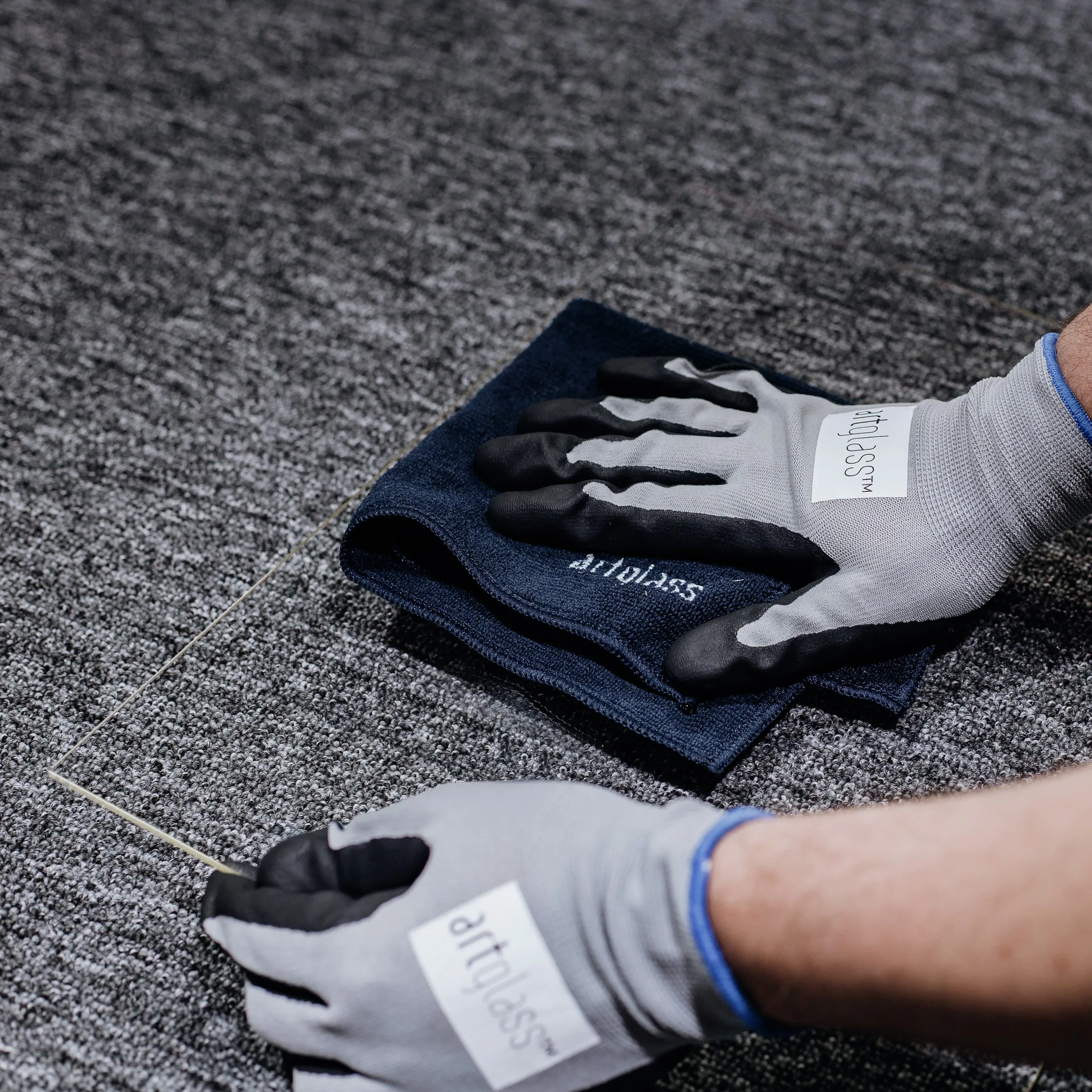
Coated picture-framing glass carries a reputation it does not deserve. Framers who have never stocked it often assume the anti-reflective coating is fragile — that cleaning needs exotic chemistry and one careless wipe will ruin a sheet. The reality is different. Artglass coatings are metal-oxide layers roughly 1/500th the width of a human hair, applied by magnetron sputtering with no direct contact with the glass surface, and the result is smooth, durable and anti-static. In the manufacturer’s own glazing comparison, cleaning Artglass is rated exactly like cleaning regular glass: easy.
What coated glazing does have is a short list of rules that differ from ordinary float glass — which cleaners to keep away from it, which side to score when cutting, and when to leave a masking film in place. This guide collects those rules in one place, taken from the official Groglass handling guidelines. And when a customer asks how to care for their new “museum glass”, the answer is the routine below.
Coated does not mean delicate
Much of the anxiety comes from confusing anti-reflective glass with anti-glare (non-glare) glass — a genuinely different product. Anti-glare glass is etched: a matte, granular surface that diffuses reflections, and that same granular texture is what makes it difficult to clean. Anti-reflective coatings work the opposite way, on perfectly smooth glass, so the surface you wipe is as flat as any float glass pane. If the distinction is new to you, our guide to anti-reflective vs non-glare glass covers it in full.
On AR 70 and AR 92 the coating is applied to both sides of the sheet in a single manufacturing step, and both coatings are equally durable — which is exactly why those two products cut and frame from either side, like regular glass. The one surface that asks for real attention is the UV-coated side of the conservation products, and the manufacturer marks it for you: on AR 99 Water White it ships under a protective masking film, and on UV 99 it is identified by a label at the glass edge. More on both below.
The cleaning routine
There is no secret product and no secret technique. Clean Artglass with any ammonia-free glass cleaner — or a 50% mix of ethanol and distilled water — and a soft microfiber cloth. That is the entire approved routine.
The avoid list is equally short: strong alkalis, strong acids, fluoride-based detergents and anything abrasive. General-purpose household sprays often fail the first test, so check the label — ammonia-free is the requirement.
Fingerprints are not a coating hazard; they wipe off with the same routine. They are a workflow hazard: a print discovered after the frame is closed means opening the frame again. Wear clean gloves for final cleaning and fitting, and each sheet gets cleaned once.
Masking films, edge labels and static
Two conservation products have a side that must face the artwork, and each one tells you which it is:
- AR 99 Water White ships with a recyclable masking film on the UV-coated side. The film protects the coating from scratches during cutting and fitting and identifies the side that faces the artwork. Leave it on for as long as possible and peel it off just before you close the frame — then dissipate the static with an anti-static brush or cloth, and the sheet is ready.
- UV 99 carries a label at the glass edge reading “This side faces artwork. Score opposite side.” If the label is already gone, a light scratch test near the edge — where the frame lip will cover it — identifies the coated side: it scratches noticeably more easily.
In both cases, frame with the UV-coated side inward, facing the artwork, so the coating sits protected inside the closed frame.
Cutting coated glass
Every glass product in the range starts from the standard score-and-break method — the differences are which side you score and, for the laminated sheet, one extra step for the interlayer.
| Product | Coating layout | How to cut |
|---|---|---|
| AR 70 | AR coating on both sides | Score either side, regular glass tools |
| AR 92 | AR coating on both sides | Score either side, regular glass tools |
| UV 99 | UV coating on one side (edge label) | Score the non-coated side only |
| AR 99 Water White | AR both sides, UV coating under masking film | Cut the film first, flip, score the glass side |
| AR 99 Protect | Two AR-coated sheets laminated with PVB | Score both sides, then cut the interlayer |
For AR 99 Water White the sequence is: score the masking film with a carbide or plastic-suitable blade, flip the sheet, score the glass side along the same line, and break. For AR 99 Protect, score one face, flip, score the second face along the same measurement, break both glass layers, then cut the PVB interlayer with a sharp, narrow blade — or ask us for cut-to-size sheets and skip the exercise.
AR 70 and AR 92 need no sequence at all: same tools, same motion, either side — which is why many framers cut them to size in-house and keep that margin for themselves. Illustrated step-by-step instructions for every product, including cutting AR 99 Water White both by hand and in a vertical cutter, are in the official PDFs on our downloads page.
Boxes, edges and storage
In the workshop, Artglass behaves like what it is: glass. Boxes of full sheets are heavy, cut edges are sharp, and the official cleaning and handling guidelines specify the PPE to wear along with safe storage practice — download them before the first box arrives, not after. The habit that pays for itself daily: leave the masking film on masked products for as long as the job allows. That is what it is there for.
Worth knowing on the quality side: every tenth sheet from the production line is tested in detail, and every cut-size sheet is manually inspected before packing — so the sheet that reaches your bench has already been looked over. And if you are still deciding which glazing to stock in the first place, start with our overview of picture framing glass types.
Acrylic plays by different rules
Lifetime Acrylic is the range’s lightweight, shatter-resistant option, and its care rules are its own. It arrives masked with protective film on both sides — as with the glass, leave the film on for as long as possible. Underneath is a hard protective top-coating that makes the sheet scratch-resistant, anti-static and easy to clean — precisely what ordinary acrylic (plexiglass) lacks, and without the haze that ordinary anti-reflective acrylics develop over time.
Cut it from either side with multi-material cutters; for the 4.5 mm and 6 mm thicknesses, use a power saw. After peeling the film, remove the static with an anti-static brush, gun or cloth — once is enough. Storage has its own rules too: keep sheets horizontal with the largest at the bottom, or vertical at no more than a 10° lean. And match thickness to format — 3 mm for standard frames, 4.5 mm above 2 × 1 m, 6 mm at 2 × 2 m and beyond.
None of this is complicated. Coated glazing differs from float glass in a handful of specific places, and it rewards the framer who knows where those places are. If a job raises a question the PDFs do not answer — an unusual fit, a cutting setup, a storage constraint — ask us. We handle this glazing every day, and a two-line e-mail now is cheaper than a scratched sheet later.
Questions
Quick answers
Can I use regular glass cleaner on anti-reflective Artglass?
Only if it is ammonia-free. The approved routine is any ammonia-free glass cleaner, or a 50% mix of ethanol and distilled water, applied with a soft microfiber cloth. Avoid strong alkalis, strong acids, fluoride-based detergents and abrasives. Many household glass sprays contain ammonia, so check the label first. Beyond that, no special products or techniques are required — the coating cleans like regular glass.
Will fingerprints or normal handling damage the coating?
No. The anti-reflective coating is a durable metal-oxide layer applied by magnetron sputtering, and fingerprints wipe off with an ammonia-free cleaner and a microfiber cloth. Gloves at final assembly are about workflow, not protection — a fingerprint discovered after the frame is closed means opening it again. The one surface to place deliberately is the UV-coated side of the conservation products, which is masked or labelled so you always know where it is.
Which Artglass products cut like regular glass?
AR 70 and AR 92 are coated identically on both sides, so they score and break from either side with regular glass tools. UV 99 and AR 99 Water White must be scored from the non-coated side — the coated side is labelled or masked so you cannot mix them up. Laminated AR 99 Protect is scored on both faces, then the PVB interlayer is cut with a sharp narrow blade. Illustrated official guidelines are free on the downloads page.
How is Lifetime Acrylic handled differently from the glass range?
It ships masked with protective film on both sides — leave the film on for as long as possible. Cut it from either side with multi-material cutters, or use a power saw for the 4.5 and 6 mm thicknesses. After peeling the film, remove static once with an anti-static brush, gun or cloth. Store sheets horizontally with the largest at the bottom, or vertically at no more than a 10-degree lean.
Not sure what fits?
Describe what you are framing and we will recommend the right level of protection — honest advice, one business day.