
Buying and cutting
How Many Frames Do You Get From a Sheet of Glass?
How many mounts each standard Artglass sheet yields, which frame sizes cut with no waste at all, and how to plan a box so it is a month of work rather than a gamble.
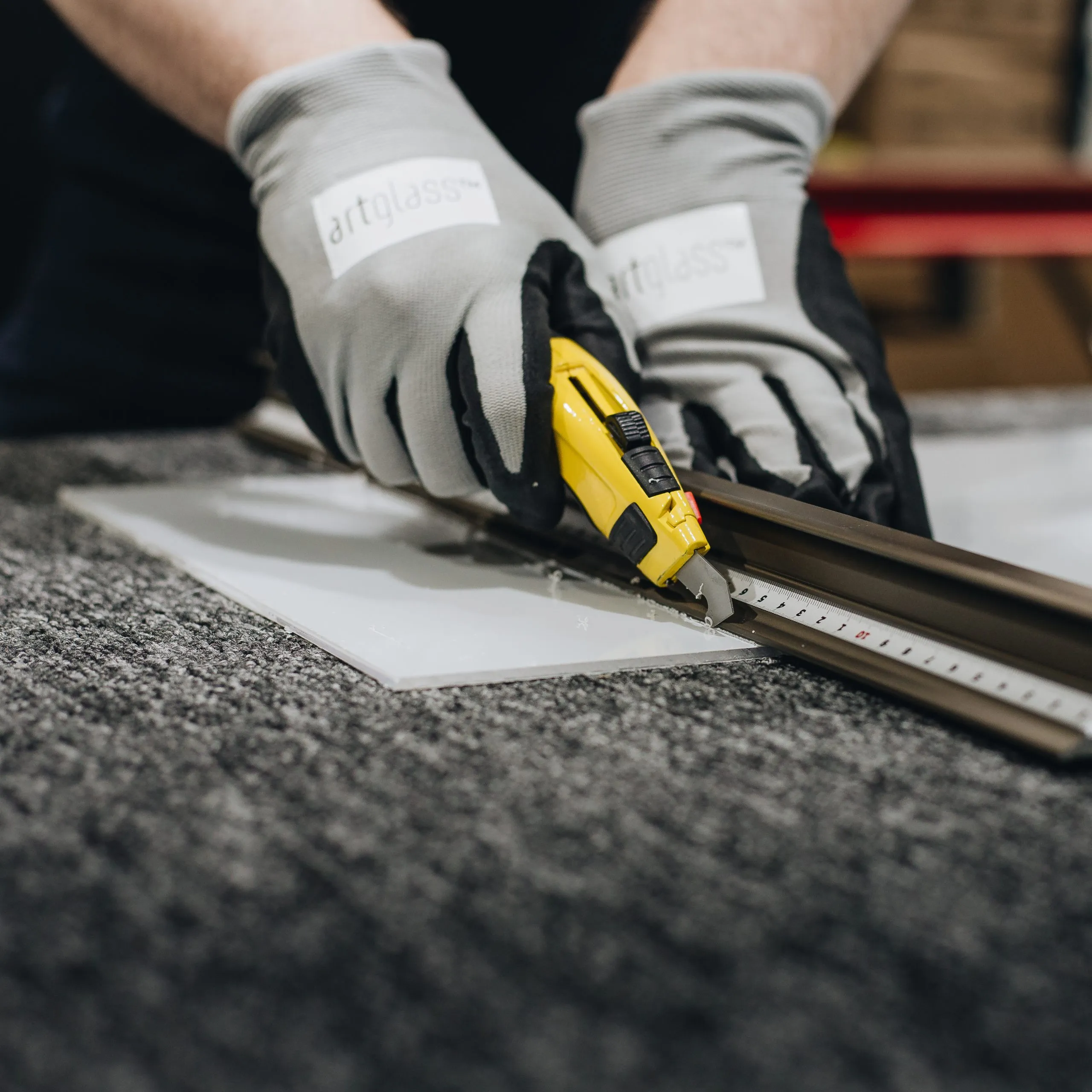
Every framer who has stood in front of a price list has done the same piece of mental arithmetic: how much of this do I actually need? It sounds like a question about square metres. It is not. It is a question about how your frame sizes divide into the sheet in front of you — and the answer changes by a factor of two depending on which sheet you pick.
This guide gives the real numbers for every standard Artglass sheet, points out the sizes that cut with no waste at all, and explains why the biggest sheet is sometimes the worst buy.
First, the unit you are actually buying
Glass leaves the factory in boxes, and a box is two sheets of one size, packed through polyethylene foil in cardboard. That is the smallest quantity of any glass product — there is no single-sheet option, because splitting a box means handling loose sheets without the packing that protects their coated faces in transit. If your job needs less than a box, that is what our cut-to-size service exists for.
So the number that matters is not frames per sheet. It is frames per box: double every figure below, and that is what actually arrives on your bench.
Frames per sheet, by size
Every figure here is calculated with the same cutting engine that runs our cut list optimiser, allowing pieces to be turned 90° within the sheet. That is safe with Artglass: the coating has no grain or direction, so a piece rotated in the plane of the sheet is identical glass. (Which face you score is a separate question — see below.)
| Finished size | 914×1219 | 1016×1524 | 1000×1600 | 1100×1600 | 1200×1600 | 1219×1727 |
|---|---|---|---|---|---|---|
| 30 × 40 cm | 9 | 11 | 12 | 14 | 16 | 17 |
| 40 × 50 cm | 5 | 6 | 8 | 8 | 9 | 9 |
| 50 × 70 cm | 2 | 4 | 4 | 4 | 5 | 5 |
| 60 × 80 cm | 2 | 2 | 2 | 2 | 4 | 4 |
| 70 × 100 cm | 1 | 2 | 2 | 2 | 2 | 2 |
| A4 | 16 | 21 | 21 | 25 | 28 | 32 |
| A3 | 8 | 10 | 11 | 11 | 14 | 16 |
| A2 | 4 | 5 | 4 | 5 | 6 | 8 |
Sheet sizes are millimetres. Multiply any figure by two for a full box. Two smaller sheets, 800 × 1100 and 800 × 1200 mm, are also made in AR 92 and AR 70; they are left out above because they rarely win on yield — a 30 × 40 mount gets six and eight pieces from them respectively, against sixteen from the 1200 × 1600.
The sizes that cut with no waste at all
Two of the commonest European frame sizes divide the 1200 × 1600 mm sheet perfectly, and it is worth knowing which:
- 30 × 40 cm — four across, four down, sixteen pieces, 100% of the sheet used. Not a millimetre of offcut. A box gives thirty-two.
- 60 × 80 cm — two across, two down, four pieces, again 100%. A box gives eight.
That is not a coincidence so much as a happy accident of the metric frame trade: 1200 is exactly four 300s, and 1600 is exactly four 400s. If your shop runs on 30 × 40 mounts, this single fact is the strongest argument for standardising on that sheet.
Most other sizes land between 85% and 95%, which is still respectable — the residue comes back as offcuts rather than dust.
Why the biggest sheet is sometimes the worst buy
Look along the A2 row. The 914 × 1219 mm sheet yields four. The 1000 × 1600 mm sheet — nearly half a square metre larger — also yields four.
The extra glass simply falls outside the grid. A2 is 420 × 594 mm, so two fit across 1000 mm with 160 mm spare, and two fit up 1600 mm with 412 mm spare. That spare is real glass you paid for and cannot use for another A2. Buy the larger sheet for that job and you have bought waste.
This is the single most useful habit to build: check the specific size instead of assuming bigger is better. It takes about fifteen seconds in the optimiser and it regularly changes the answer.
Turning pieces changes the answer more than you would think
The 30 × 40 figure for the largest sheet, 1219 × 1727 mm, is seventeen rather than the sixteen you get from straightforward grid cutting. The seventeenth piece only appears if you mix orientations across the sheet: three bands of turned pieces, two bands of upright ones, stacking to 1700 mm of the available 1727.
Nobody finds that layout with a pencil, and that is rather the point — it is exactly the kind of packing a solver is good at and a tired framer at five o’clock is not. It is also why the optimiser prints the cut sequence in the order you should make the cuts, instead of leaving you to reconstruct it at the bench.
If your artwork dictates a direction and pieces must not be turned, switch rotation off — the tool will tell you honestly what that costs.
Which face to score
Turning a piece within the sheet is free. Turning the sheet over is not, and the rule differs by product: AR 70 and AR 92 are coated identically on both faces and score from either side, exactly like float glass. UV 99 and AR 99 Water White are scored from the non-coated side only. Laminated AR 99 Protect needs scoring on both faces before the interlayer is cut. Illustrated handling guidelines for each are free on our downloads page — worth pinning up before a first box of a product you have not cut before.
Mixed weeks are where the offcut matters
A single-size run is easy. Real weeks are not. Take a fairly typical mixed batch: six 30 × 40, four 40 × 50 and three 50 × 70 mounts.
On 1200 × 1600 mm glass, that is thirteen pieces from two sheets — one box — using 67% of the glass, in sixteen cuts. The remaining third does not vanish: the largest offcut is 900 × 1200 mm, comfortably enough for several more mounts, and four smaller pieces are still worth keeping.
That is the honest way to read a box. It is not “a week’s work plus a pile of scrap”; it is a week’s work plus the beginnings of next week’s, provided you cut the sheet as a whole rather than one job at a time. Cutting job-by-job is what turns usable offcuts into narrow strips.
What to keep on the shelf
Three sheet sizes of Artglass AR 70 are held in our Mārupe warehouse and ship immediately: 1000 × 1600, 1100 × 1600 and 1200 × 1600 mm. For a 30 × 40 mount those give twelve, fourteen and sixteen pieces respectively — so the largest of the three is the obvious default, and it is the one that cuts with no waste.
Everything else in the range is made to order at the Groglass factory in Riga, normally one to two weeks. That is not a problem when you are planning; it is only a problem when you are not. Knowing that your regular size needs a box every six weeks is worth more than any discount.
When cutting your own is the wrong answer
Buying sheets is not automatically right. Order the pieces cut to size instead when:
- You are trying a product for the first time. A box is a commitment to a product you have not lived with yet. Cut pieces let you put AR 92 or AR 99 Water White in front of a customer before you stock it.
- The job is a one-off. If a single 50 × 70 is all you need, a box of glass is not the efficient purchase, whatever the per-square-metre figure says.
- The sizes are awkward. Some dimensions simply do not divide well into any standard sheet. The optimiser will show you a poor yield, and that is a signal worth heeding.
Cut-to-size is available in Latvia and the Baltics on the 2 mm products, from 100 × 100 mm up to 1180 × 1580 mm, cut to ±1 mm. For larger formats, Lifetime Acrylic can be ordered online a single sheet at a time in eleven sizes up to 1970 × 2580 mm — it is shatter-resistant, so it ships as one piece without crating.
Plan it once, print it, cut it
The arithmetic above is worth internalising for your two or three regular sizes. For everything else, put the list into the cut list optimiser: it works out how many boxes the job needs, draws each sheet, prints a cut list you can carry to the bench and tick off, and tells you what the offcuts still cover. It is free, it needs no account, and your sizes never leave your browser.
When you know the quantity, build the request and we will come back with pricing, availability and lead time — usually within one business day.
Questions
Quick answers
How many 30 × 40 cm mounts come from one sheet of glass?
From the 1200 × 1600 mm sheet, exactly sixteen — with no offcut at all, because 30 × 40 cm divides that sheet perfectly four ways in both directions. A box of two sheets gives thirty-two. Smaller sheets give less: twelve from 1000 × 1600 and fourteen from 1100 × 1600. The largest standard sheet, 1219 × 1727 mm, yields seventeen, but only if some pieces are turned 90°.
Can I buy a single sheet of glass?
Not of the glass products. The smallest quantity is one full manufacturer box, which is two sheets of one size — glass is packed that way at the factory and splitting a box means handling loose sheets without their protective packing. If you need less than a box, order the pieces cut to size instead; that is exactly what the service is for. Artglass Lifetime Acrylic is the exception and can be ordered online one sheet at a time.
Does a bigger sheet always give more frames?
No, and this is the most common planning mistake. An A2 mount at 420 × 594 mm gets four pieces out of the 914 × 1219 mm sheet and also only four out of the 1000 × 1600 mm sheet, despite the second being nearly half a square metre larger — the extra glass falls outside the grid and becomes offcut. Always check the specific size rather than assuming the largest sheet wins.
How much glass is wasted when cutting to standard frame sizes?
Far less than most framers expect, if the sheet is chosen deliberately. Several common European sizes cut with zero waste: 30 × 40 cm and 60 × 80 cm both divide the 1200 × 1600 mm sheet exactly. Across a mixed week of work, planning the layout rather than cutting each job as it arrives typically lands between 85% and 95% of the sheet used, with the remainder in offcuts large enough to keep.
Which sheet size should a framing workshop keep in stock?
For most workshops, 1200 × 1600 mm. It is the best all-rounder across common frame sizes, it cuts 30 × 40 and 60 × 80 cm with no waste, and in Artglass AR 70 it is one of three sizes held in our Mārupe warehouse for immediate dispatch — the others being 1000 × 1600 and 1100 × 1600 mm. Anything else is made to order at the Groglass factory, normally one to two weeks.
Ready to choose your glazing?
Build a structured glass quote — products, sizes, box quantities — and we reply with prices and availability within one business day.