
Glazing types
Anti-Reflective vs Non-Glare Glass: What's the Difference?
Non-glare glass scatters reflections and blurs with mats; anti-reflective coatings remove them. How each works, honest trade-offs, and which to choose.
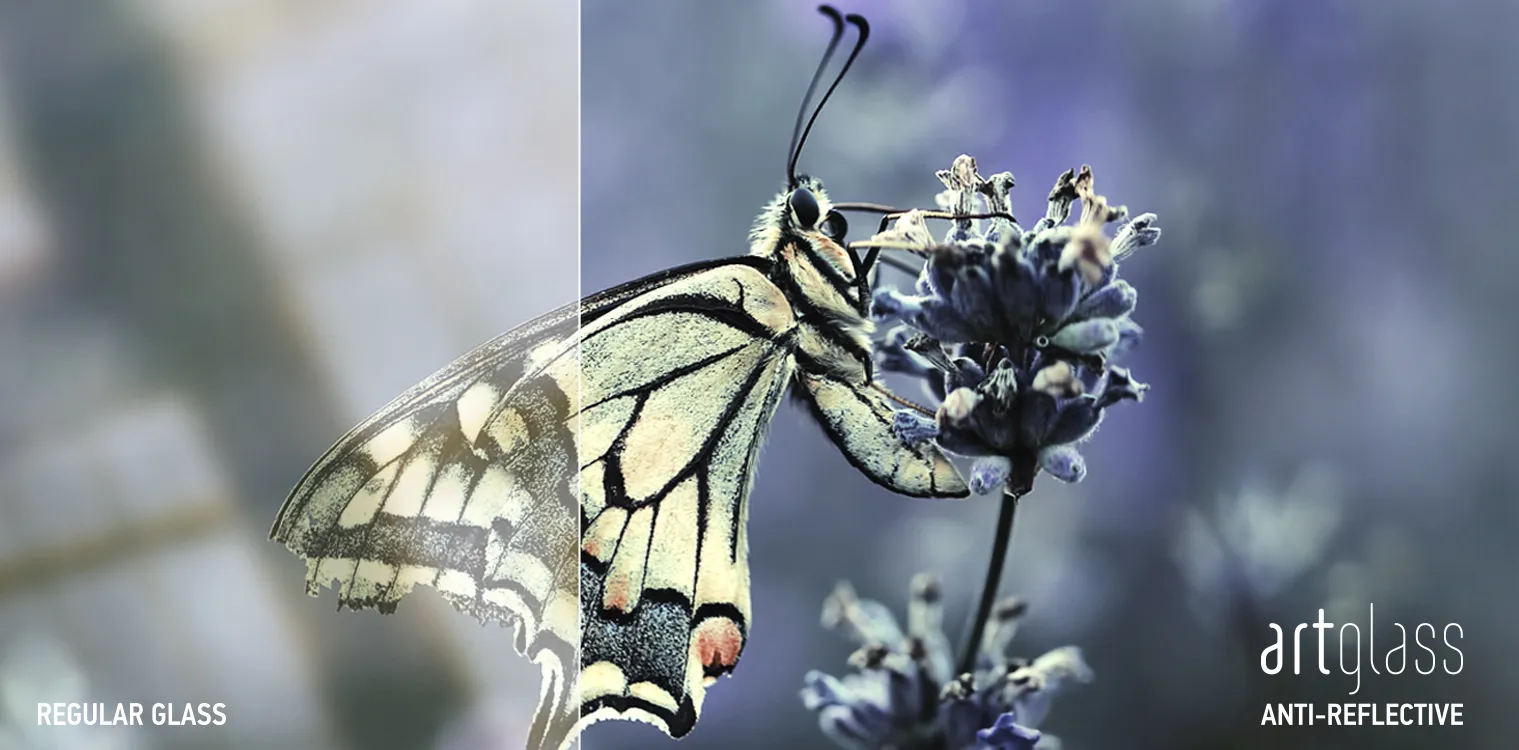
Two products promise to solve the same problem — reflections on framed art — and their names get used interchangeably every day: non-glare glass and anti-reflective glass. They are not the same product. One scatters reflections, the other removes them, and that single difference decides how sharp the artwork looks, what happens the moment you add a mat, how the glazing cleans, and whether the customer is still happy once the frame is on the wall rather than on the counter.
We supply the coated anti-reflective kind, so we have an obvious interest here — but the honest version of this comparison is the useful one, because there are jobs where etched non-glare glass is a perfectly reasonable choice. Here is how each technology actually works, where each belongs, and why UV protection is a separate question entirely.
What non-glare glass actually is
Start with what all smooth glass does: when light hits it, about 8% bounces straight back at the viewer as a mirror-like reflection — windows, lamps, the viewer’s own silhouette sitting on top of the image.
Non-glare glass (also sold as anti-glare) attacks that mirror with an etched, matte surface. The etching diffuses incoming light in many directions, so one crisp reflection becomes a soft overall sheen. Roughly the same amount of light still reflects — it is scattered, not removed.
The catch is that a diffusing surface cannot tell direction. The same texture that scatters light arriving from the room also scatters the light coming back from the artwork. The image picks up a slight haze and fine detail softens — and the softening grows with the distance between glazing and artwork. Pressed directly against a print, it is modest. Add a mat or spacers and the scattered image light spreads further before it reaches the eye: edges blur visibly, and in a deep frame or shadow box the etched surface is simply not suitable.
Two more trade-offs worth knowing: the granular surface makes cleaning noticeably harder than smooth glass, and etching improves nothing else — light transmission stays around 89–90% and UV protection at the 20–45% of regular glass.
What anti-reflective glass actually is
Coated anti-reflective glass takes the opposite approach: instead of scattering the reflection, it prevents it from forming. Microscopic metal-oxide layers — about 1/500th the width of a human hair — are applied to both sides of the glass by magnetron sputtering. These optical interference coatings manipulate light waves so they pass through to the artwork instead of bouncing back. Reflection drops from about 8% to around 1%, and light transmission rises to roughly 98% — for practical purposes, the glass disappears.
Because the surface stays perfectly smooth, nothing is diffused in either direction. The image stays sharp at any depth — deep frames and multi-mat builds are exactly where coated glass looks most impressive — and it cleans like regular glass: ammonia-free cleaner, soft microfiber cloth. Physics does not allow glass to vanish entirely, so a faint residual reflection remains, visible at an angle as a neutral colour tint — green on most Artglass products, ocean-blue on AR 92 — much like coated prescription lenses.
This coated category is what people usually mean when they search for “museum glass”. Our own term for the conservation-level products is museum-grade — and the name matters less than the numbers behind it.
The two side by side
The reflection percentage is only half the story; read the surface and depth columns together.
| Glazing | Visible reflection | Light transmission | UV protection | Surface | Mats & deep frames |
|---|---|---|---|---|---|
| Regular float glass | ~8% | ~89–90% | 20–45% | Smooth | OK — reflective but sharp |
| Non-glare (etched) | ~8%, scattered | ~89–90% | 20–45% | Matte, granular | Blurs with depth — not suitable |
| Anti-reflective (coated) | ~1% | ~98% | Up to 99%, by product | Smooth | Sharp at any depth |
When each one is the right call
Non-glare is fine more often than a glass supplier likes to admit
It is usually chosen on budget grounds, and when the artwork sits directly against the glazing — no mat, no spacer — its softening is at its minimum. For decorative posters, reproducible prints, certificates and pieces hung under harsh lighting where nobody studies the surface from thirty centimetres, non-glare does the job it was bought for, and pushing coated glass there is upselling, not advice.
Where it stops being fine: matted work of any kind, detailed photography and fine art, and any frame the customer will compare side by side with clear glazing. One caution regardless of budget: non-glare says nothing about UV. If the piece can fade, the etched surface will not save it.
Where coated anti-reflective earns its price
The moment there is distance between glazing and artwork — a single mat is enough — coated glass stops being a luxury. It is the only option that controls reflections and keeps the image sharp:
- matted and double-matted work, spacers, shadow boxes and deep frames;
- photography and detailed artwork, where softening shows immediately;
- gallery and exhibition framing viewed from changing angles under mixed light;
- any job where the customer sees a side-by-side — once the glass disappears, it is hard to go back.
The entry point is Artglass AR 70 — the accessible upgrade from regular glass — with reflection under 1%, a UV block above 70%, and the same score-and-break cutting as regular glass, from either side, so it slots into an everyday workflow without new equipment.
UV protection is a separate decision
The second conflation this topic suffers from: neither “non-glare” nor “anti-reflective” tells you anything about UV. Both terms describe what happens to visible light at the surface. UV protection comes from separate coatings, and UV damage is cumulative and irreversible — the one specification you cannot fix after the fact.
The Artglass range deliberately keeps the two choices independent. The anti-reflective products share the same near-invisible optics but offer three UV levels: over 70% on AR 70 for reproducible work, about 92% on AR 92 for photography and controlled-light spaces, and 99% — certified to EN 410 — on AR 99 Water White for originals, watercolours and anything irreplaceable. And if reflections are tolerable but fading is the worry, Artglass UV 99 blocks 99% of UV while looking like regular glass. Choosing the right level is a guide of its own: UV protection for framed art.
Choosing in practice
Strip away the naming confusion and the decision is short. If the artwork touches the glazing and the piece is replaceable, non-glare is a defensible choice — go in knowing it softens the image and adds no UV protection. If there is a mat, a spacer or any depth at all; if detail matters; if the work can fade — coated anti-reflective glass is the tool for the job, and the UV level should match how replaceable the piece is.
If you already know your sizes, send them through our glass quote builder and we will put together an offer for the exact products and quantities. Still weighing the options? Request samples — this particular difference is far easier to see than to read about.
Questions
Quick answers
Why does non-glare glass look blurry over a mat?
Because the etched surface scatters light in both directions — the reflections coming from the room and the image light coming from the artwork. The further that image light travels before reaching your eye, the wider the scatter spreads, so a mat or spacer makes the softening clearly visible. Pressed directly against the artwork the haze is modest; in a deep frame it obscures detail badly enough that etched glass is not recommended at all.
Is anti-reflective glass the same as museum glass?
The phrase museum glass is used loosely for coated anti-reflective glazing with conservation-level UV protection. The two properties are separate: an anti-reflective coating brings reflection down to about 1%, while UV protection depends on the product. In the Artglass range the museum-grade option is AR 99 Water White — under 1% reflection, roughly 98% light transmission and a 99% UV block certified to EN 410 on low-iron glass.
Does non-glare glass protect artwork from fading?
Not meaningfully more than regular glass. Etching changes only the surface texture, so a typical non-glare sheet still passes most UV light — around 20 to 45% is blocked, the same as ordinary glazing. UV damage is cumulative and irreversible, so if the framed piece can fade, choose the UV level deliberately: Artglass offers 70, 92 and 99 percent options independent of the anti-reflective question.
How do I tell etched and coated glass apart by eye?
Hold the sheet at an angle to the light. Etched non-glare glass shows a milky, matte sheen across the surface. Coated anti-reflective glass stays smooth and clear with only a faint residual colour tint — green on most Artglass products, ocean-blue on AR 92 — much like coated prescription lenses. Then hold each over printed text and lift it away: etched glass softens the letters as the distance grows, coated glass keeps them sharp.
Ready to choose your glazing?
Build a structured glass quote — products, sizes, box quantities — and we reply with prices and availability within one business day.