
Choosing glazing
Picture Frame Glass Thickness: 2 mm, 3 mm, Laminated or Acrylic?
How thick picture frame glass is, when 3 mm or laminated glass makes sense, which acrylic thickness large frames need, and what thickness does to weight and rebate depth.
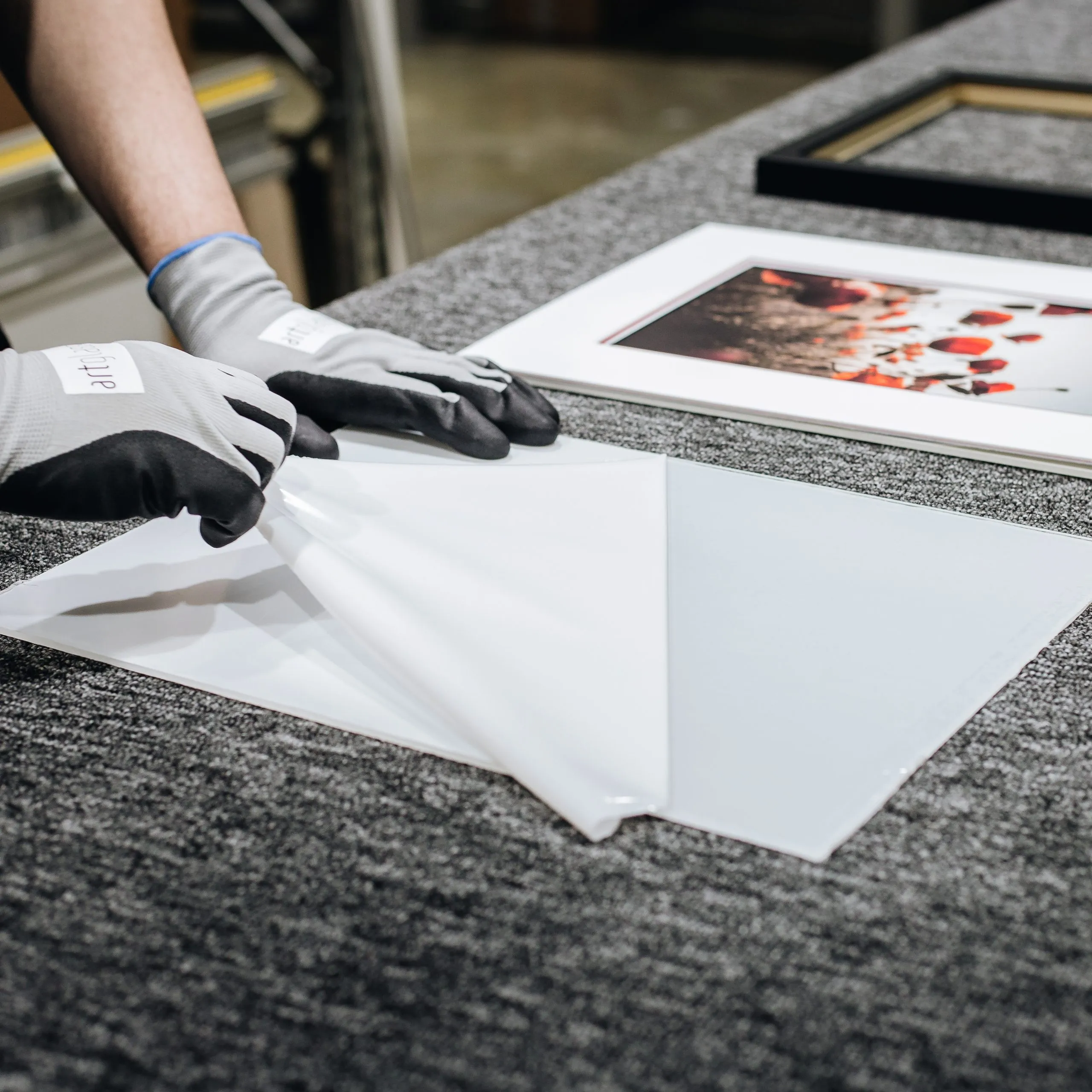
Ask a framer how thick picture frame glass is and the answer comes back without a pause: 2 mm. That is right for almost everything that crosses the bench. But thickness is not a single number once the work gets large, public or valuable. Then the choice widens to 3 mm glass, laminated safety glass at 4.4 mm and up, and acrylic in three thicknesses, and each one changes the weight, the rebate depth and the way the glazing is cut.
This guide sets out which thickness each Artglass product comes in, when going thicker earns its weight, and the one rule that is not a matter of taste: acrylic for large frames.
The short answer, product by product
| Product | Thickness | Sheet sizes |
|---|---|---|
| AR 99 Water White | 2 mm | Standard sizes up to 1219 × 1727 mm |
| AR 92 | 2 or 3 mm | Standard sizes in 2 mm; large sheets 1580 × 2210 and 2210 × 3160 mm in 2 or 3 mm |
| AR 70 | 2 or 3 mm | Standard sizes in 2 mm; large sheets 1580 × 2210 and 2210 × 3160 mm in 2 or 3 mm |
| UV 99 | 2 mm | Standard sizes up to 1219 × 1727 mm |
| AR 99 Protect | 4.4 or 6.4 mm, up to 13.5 mm on request | Large laminated sheets |
| Lifetime Acrylic | 3, 4.5 or 6 mm | 11 standard sheets, 405 × 510 to 1970 × 2580 mm |
The standard glass sizes run from 800 × 1100 to 1219 × 1727 mm. The large sheets are on our price list in 2 and 3 mm for AR 70 and AR 92 and in 4.4 mm for AR 99 Protect; they travel on the manufacturer’s A-frames rather than in boxes.
Why 2 mm is the standard
Most framed work is well under a metre on its longest side, and at that size 2 mm glass does everything asked of it. It is stiff enough to sit flat in the rebate, light enough not to dictate the hanging hardware, and it scores and snaps with an ordinary cutting wheel. Groglass describes the 2 mm thickness of AR 70 as being “for easy handling”, and that is the practical case in a sentence.
Thickness also touches clarity. Groglass notes that glass thickness “has an impact on glass clarity and the weight of the final frame”. Any tint in the glass itself builds up through its depth: ordinary float glass looks green at the edge, and greener the thicker it gets. That is why the anti-reflective Artglass glass products are made on low-iron glass, which keeps colours clear and natural. UV 99 is the exception: it is a clear float glass, made in 2 mm.
When 3 mm glass makes sense
There is no size at which glass has to move to 3 mm. Groglass calls glass thickness partly “a matter of preference”, and AR 70 and AR 92 are made in 2 mm even in the largest sheets, 2210 × 3160 mm. The reason to choose 3 mm is stiffness. A plate’s stiffness rises with the cube of its thickness, so 3 mm glass is about three and a half times as stiff as 2 mm. On a large sheet that means less flex while it is carried, cut and lowered into the frame.
The cost is weight: 3 mm glass weighs half as much again as 2 mm. In the Artglass range, 3 mm exists in AR 70 and AR 92, in the two large sheet sizes. AR 99 Water White and UV 99 are made in 2 mm only. For a large museum-grade frame, Groglass recommends Lifetime Acrylic instead, which also brings the weight down.
Laminated glass: 4.4 mm and up
AR 99 Protect is a different kind of glazing rather than a thicker version of the same one. It is two sheets of low-iron glass bonded to a PVB interlayer, made in 4.4 and 6.4 mm, with heavier build-ups up to 13.5 mm on request. The thickness comes from the construction: the interlayer holds the glass together if it breaks, which is why it belongs in public spaces, high-traffic galleries and museums. It keeps the anti-reflective coating and blocks up to 100% of UV.
Two practical consequences follow from the construction:
- Cutting takes two scores. Score one face, turn the sheet, score the other face on the same line, break it, then cut the PVB interlayer with a sharp, narrow blade.
- Factory cutting is ordered by the sheet. Groglass can cut AR 99 Protect precisely from 250 × 250 up to 2900 × 1900 mm in 4.4 or 6.4 mm. The minimum order is one full large sheet, cut into your sizes, so it pays off for a set of pieces rather than a single pane.
Acrylic: 3, 4.5 or 6 mm
Acrylic is the one place where thickness follows a rule rather than a preference, because acrylic can bow slightly with environmental changes. Over a small span that does not show; over a large one it does, which is why the thickness steps up with the size of the frame. The manufacturer’s guidance for Lifetime Acrylic is:
- 3 mm for standard formats
- 4.5 mm for frames larger than 2 × 1 m
- 6 mm for frames of 2 × 2 m and above
The online order page applies the same guidance: when a cut piece approaches that range in 3 mm, it suggests going thicker. In practice, 3 mm comes in all eleven standard sheet sizes, 4.5 mm in 1220 × 1830, 1830 × 2440 and 1970 × 2580 mm, and 6 mm in the largest sheet, 1970 × 2580 mm. Pieces cut to size are available in all three thicknesses, up to 1930 × 2540 mm.
Cutting changes with thickness too. Groglass recommends multi-material cutters or acrylic-rated saw blades, and a power saw for the 4.5 and 6 mm sheets.
What thickness does to the weight of a frame
Weight is where thickness shows up on the wall. The figures below are calculated from standard material densities, not taken from manufacturer data, but they are close enough for choosing fixings.
| Glazing | Approx. weight per m² |
|---|---|
| Glass, 2 mm | 5 kg |
| Glass, 3 mm | 7.5 kg |
| Laminated glass, 4.4 mm | 10.5 kg |
| Laminated glass, 6.4 mm | 15.5 kg |
| Acrylic, 3 mm | 3.6 kg |
| Acrylic, 4.5 mm | 5.4 kg |
| Acrylic, 6 mm | 7.1 kg |
A 1000 × 1600 mm frame carries about 8 kg of glazing in 2 mm glass, 12 kg in 3 mm glass and under 6 kg in 3 mm acrylic.
The honest reading of the table: acrylic weighs about half as much as glass of the same thickness, and far less than laminated glass. Past 2 × 1 m, though, the recommended 4.5 mm acrylic weighs about the same as 2 mm glass. At that size the case for acrylic is that it will not shatter and is safe to transport. Against 3 mm or laminated glass, the weight saving is still large.
Check the rebate before you go thicker
The rebate has to hold everything stacked behind the face of the frame: glazing, mounts or spacers, the artwork and the backing. Moving from 2 mm glass to 4.4 mm laminated glass or 6 mm acrylic uses up several millimetres of it. In a moulding chosen for 2 mm glass, that can leave no room for the backing board or the fixings. Measure the full stack before you specify a thicker glazing, not after it arrives.
Choosing in practice
- Everyday framing, up to about a metre: 2 mm glass. Pick the product by the UV level the work needs: AR 70, AR 92, AR 99 Water White or, without the anti-reflective coating, UV 99.
- Large glass frames: 2 mm works, even in the largest AR 70 and AR 92 sheets. Choose 3 mm if you want a stiffer sheet and can carry the extra weight.
- Public spaces, or work that must not be exposed if the glass breaks: AR 99 Protect, 4.4 mm or thicker.
- Large, travelling or shipped work: Lifetime Acrylic at the thickness the manufacturer recommends for the size.
If you are working out how many frames a standard sheet gives at a particular size, see how many frames you get from a sheet of glass. For cutting coated glass, the cleaning and handling guide covers which side to score. And if a job falls between thicknesses, send it through the glass quote builder with the sizes: we reply within one business day.
Questions
Quick answers
What thickness is standard picture frame glass?
2 mm. Artglass AR 99 Water White, AR 92, AR 70 and UV 99 are all made in 2 mm in the standard framing sizes, up to 1219 × 1727 mm. AR 70 and AR 92 also come in 3 mm, in large sheets. Laminated AR 99 Protect starts at 4.4 mm, and Lifetime Acrylic comes in 3, 4.5 and 6 mm.
Is 3 mm glass better than 2 mm for picture frames?
Not as a rule. The anti-reflective coating and the UV level are the same at either thickness. What 3 mm adds is stiffness, which helps when handling and fitting very large sheets, and it weighs half as much again. Groglass calls glass thickness partly a matter of preference, and AR 70 and AR 92 are made in 2 mm even in the largest sheets. In the Artglass range, 3 mm is available in AR 70 and AR 92 large sheets.
What thickness of acrylic should I use for a large frame?
The manufacturer's guidance for Artglass Lifetime Acrylic is 3 mm for standard formats, 4.5 mm for frames larger than 2 × 1 m and 6 mm for frames of 2 × 2 m and above. Acrylic can bow slightly with environmental changes, and a thicker sheet resists that over a large span.
How much does picture frame glass weigh?
About 5 kg per square metre at 2 mm and about 7.5 kg at 3 mm. Laminated 4.4 mm safety glass is about 10.5 kg per square metre. Acrylic weighs roughly half as much as glass of the same thickness: about 3.6 kg per square metre at 3 mm. These are approximations from standard material densities, not manufacturer figures.
Why is laminated glass thicker than ordinary picture glass?
Because it is two sheets of glass bonded to a PVB interlayer. Artglass AR 99 Protect is made in 4.4 and 6.4 mm, with heavier build-ups up to 13.5 mm on request. The interlayer is what holds the glass together if it breaks, which is the point of using it in public spaces and museums.
Ready to choose your glazing?
Build a structured glass quote — products, sizes, box quantities — and we reply with prices and availability within one business day.