
Glass substrates
Water White Glass: Why Low-Iron Glass Matters in Picture Framing
What water white glass is, why ordinary glass looks green at the edge, where low-iron glass shows in a frame, and when plain float glass is good enough.
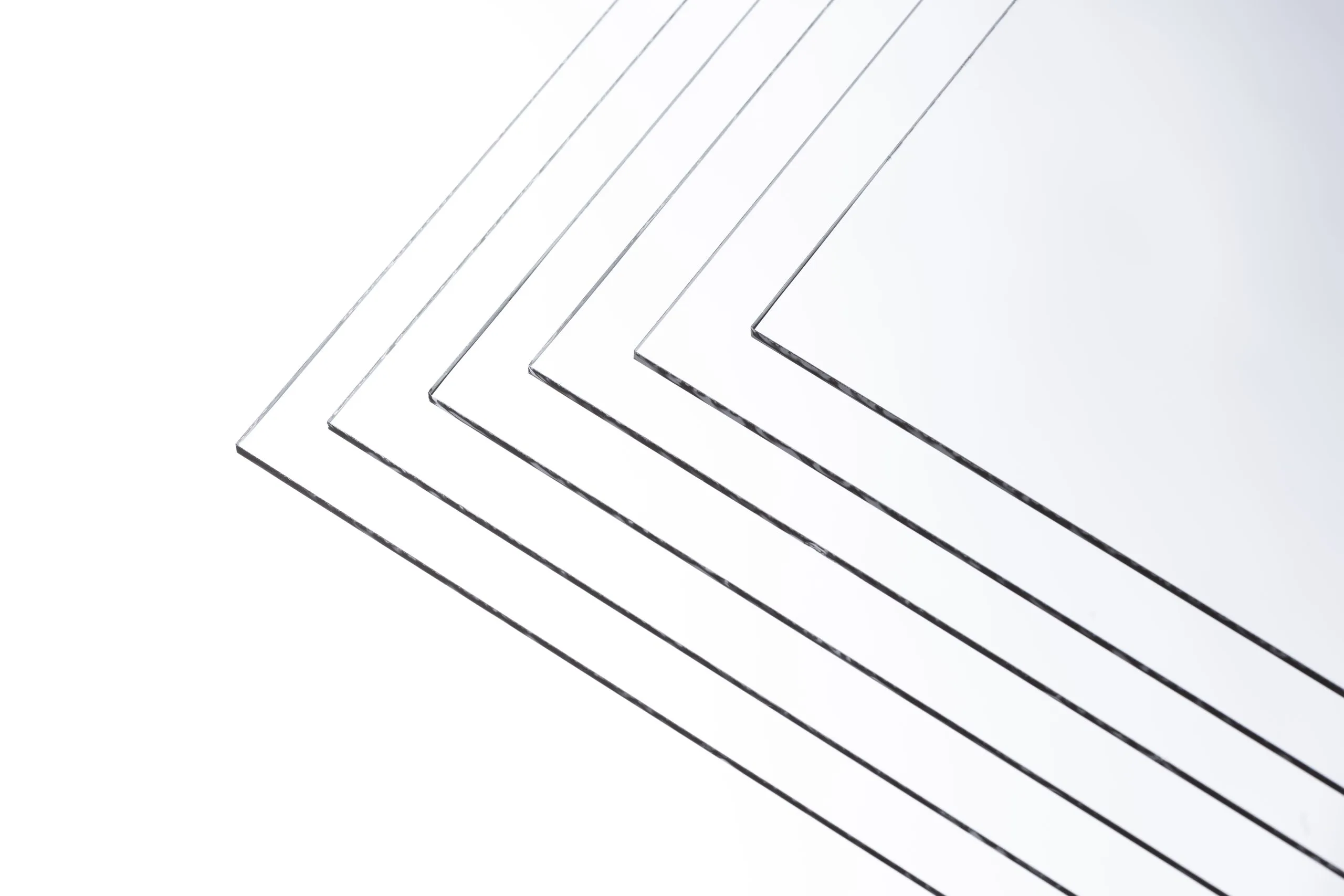
Pick up a sheet of ordinary picture glass and look at its edge. It is green, sometimes a deep bottle green. That colour is iron, and it is in the face of the glass too, only fainter. “Water white” is the name the trade uses for glass with most of that iron taken out: low-iron glass, which looks almost colourless even edge-on.
Most people never notice the tint behind a frame, because they have nothing to compare it with. Framers notice it as soon as a white mount sits under two different glasses side by side. This guide explains where the green comes from, where low-iron glass makes a visible difference, how it relates to anti-reflective coatings and UV protection, and when ordinary float glass is good enough.
What water white glass is
Almost all flat glass is float glass: molten glass poured onto a bath of molten tin, where it spreads into a flat, even sheet. The raw materials for ordinary float glass contain some iron, and iron oxide absorbs a little of the light passing through the glass, least of all in the green part of the spectrum. What comes out the other side leans green.
Low-iron glass is made the same way from purer raw materials, with much less iron in the mix. Groglass describes the two substrates plainly in its framing guide. Low-iron glass is “also referred to as ‘water white glass’”, with the purest colour resolution because of the low iron content, and it is used where clarity and precision are paramount. Standard float glass is “also referred to as ‘clear glass’” and has a slight green tint because of the iron content; it suits products where clarity is secondary.
So “clear glass” is, slightly confusingly, the one with the tint.
Why the edge gives it away
Through the face of a 2 mm sheet, light crosses 2 mm of glass, and the tint is faint. Looking at the edge, you look along the sheet through its whole width, so even a small amount of colour adds up into the green you see on a cut. Low-iron glass has the same depth to look through, but so little iron that the edge stays pale.
The same logic explains why thickness matters. The tint builds with depth, so 3 mm float glass is greener than 2 mm, and laminated glass, two sheets bonded together, has about twice the glass of a single 2 mm sheet. That is where a low-iron substrate counts most, and the laminated AR 99 Protect is made from two sheets of low-iron glass. Groglass notes that glass thickness “has an impact on glass clarity”, and our guide to picture frame glass thickness covers the rest of what changes as glass gets thicker.
Where it shows in a frame
The tint is a colour cast, so it shows wherever the eye expects a neutral colour:
- White and off-white mounts. A bright white mount is the most common reference point in a frame, and under float glass it takes on a faint cool, greenish cast.
- Paper and light work. Watercolours, drawings, pale skies and the paper margins of prints are where colour accuracy is easiest to judge and easiest to lose.
- Black-and-white photographs. Any cast reads as a change of tone, which is the one thing a photographer did not ask for.
- Side-by-side hanging. In a gallery or a run of matching frames, glass with and without the tint can look like two different whites.
On a dark, saturated image the tint is much harder to spot. What a viewer notices there is reflection, and that is a coating question rather than a glass question.
Low-iron and anti-reflective: two different jobs
Low-iron glass and anti-reflective glass are often talked about as one thing, because the best framing glass is both. They are separate properties, and it helps to know which one does what.
Regular glass reflects about 8% of visible light and lets roughly 89–90% through. Artglass anti-reflective glass reflects about 1% and lets about 98% through. Most of that gain comes from the coating: cutting reflection from 8% to 1% accounts for about seven of the eight or nine points. What the low-iron substrate adds is that the light which does come through has not been tinted on its way to the artwork.
That is why the substrate matters even on coated glass. Anti-reflective coatings are also sold on ordinary float glass, which removes the reflections and keeps the green. Groglass makes the comparison directly for Artglass AR 70: float glass “contains iron, which gives it a green tint and can change the look of artwork”, while AR 70 is made on premium low-iron glass “so colors stay clear and natural”. All four Artglass anti-reflective glass products are made on low-iron glass.
One thing that looks like a tint and is not: the faint colour in the reflection. Every anti-reflective coating leaves a small residual reflection with a slight colour of its own, neutral green on most Artglass products and neutral blue on AR 92. It sits in the reflection, not in the glass, and Groglass keeps it stable and uniform at any viewing angle. A faint green glint on AR 70 is the coating, not iron.
Where UV protection comes in
UV protection adds a second source of colour. Blocking ultraviolet light means stopping light just short of the visible violet, and pushing protection all the way to 99% can cost some colour. Groglass describes “the green and brown undertones of conventional UV-blocking glass”, and the two higher Artglass UV grades handle it in different ways.
- AR 92 dials its UV block back slightly, in Groglass’s words “to leave the visible light unimpeded by absorption”. Groglass recommends it for photography.
- AR 99 Water White, launched in 2021, combines the full 99% UV block with a reduced-iron substrate and improved coatings. Groglass says its technology has made it possible “to nearly fully eliminate disturbing tinting and shading”, and calls it the clearest museum-grade glass on the market. The product carries the substrate in its name, but it is not the only low-iron product in the range; it is the one that combines low-iron glass with conservation-grade UV protection.
For what the different UV levels protect against, see our guide to UV protection for framed art.
Which Artglass products are low-iron
| Product | Substrate | Transmission | Reflection | Reflection colour |
|---|---|---|---|---|
| AR 70 | Low-iron glass | ~98% | ≤ 1% | Neutral green |
| AR 92 | Low-iron glass | ~98% | ≤ 1.2% | Neutral blue |
| AR 99 Water White | Low-iron glass (water white) | ~98% | ≤ 1% | Neutral green |
| AR 99 Protect | Laminated low-iron glass | ~97.5% | ≤ 1% | Neutral green |
| UV 99 | Premium float glass | ~89% | ~8% | None |
| Lifetime Acrylic | Hard-coated acrylic | ~98% | ≤ 1.1% | Neutral green |
Acrylic contains no iron, so the question does not arise for Lifetime Acrylic; Groglass describes it as made from “the purest acrylic substrate”.
When float glass is good enough
Groglass’s own description of float glass is fair: suitable “where clarity is secondary”. There are plenty of framing jobs like that, and Artglass UV 99 is built for them. It is premium float glass with a 99% UV block and no anti-reflective coating, so it looks like regular glass and costs less than the anti-reflective range. If the job is to stop a print or a photograph fading, and the customer is happy with the look of ordinary glass, UV 99 does that job.
Low-iron glass earns its place when the glass is meant to disappear: anti-reflective glazing, white mounts, pale and paper-based work, photographs and anything the customer will look at closely.
How to see the difference
The difference is easier to see than to describe. Lay a low-iron sample and a piece of your current glass side by side on a white mount, then look at the mount through each and at the two edges. If you would like to try it with Artglass, request samples and tell us what you usually frame.
When you are ready to price a job, get the glass price list by email, or send your sizes through the glass quote builder: we reply within one business day. For the rest of the glazing decision, start with picture framing glass types, or see what makes glass museum grade.
Questions
Quick answers
What is water white glass?
Water white is the trade name for low-iron glass. Ordinary float glass contains iron, which gives it a slight green tint that you can see most clearly at the edge of a sheet. Low-iron glass is made with far less iron, so it looks almost colourless and whites stay white behind it. Groglass makes its anti-reflective Artglass glass on a low-iron substrate.
Why does picture frame glass look green?
Because of the iron in ordinary float glass. Iron oxide absorbs a little of the light passing through, so the light that comes out leans green. Through the face of a 2 mm sheet the tint is faint, but looking at the edge you see through the whole width of the sheet, and the colour builds up into the familiar bottle green.
Is low-iron glass the same as anti-reflective glass?
No. They are two separate properties. The anti-reflective coating cuts reflection from about 8% to about 1%; the low-iron substrate keeps the glass itself from tinting the artwork. Anti-reflective coatings are also sold on ordinary float glass, which removes the reflections but keeps the green. Every Artglass anti-reflective glass product is made on low-iron glass.
Is all Artglass glass low-iron?
The anti-reflective glass is: AR 70, AR 92, AR 99 Water White and the laminated AR 99 Protect are all made on low-iron glass. Artglass UV 99 is on premium float glass, because its job is UV protection at an accessible price, not optical clarity. Lifetime Acrylic is acrylic, so iron does not come into it.
Why does anti-reflective glass have a green or blue reflection?
That colour comes from the coating, not from iron in the glass. Every anti-reflective coating leaves a faint residual reflection with a slight colour. On AR 70, AR 99 Water White, AR 99 Protect and Lifetime Acrylic it is neutral green, and on AR 92 it is neutral blue. Groglass makes it stable and uniform at any viewing angle.
Want the numbers?
Leave your e-mail and the current Artglass B2B glass price list lands in your inbox — delivery terms for your market included.